Everyone Lives in McDonald’s Shadow. We Measured the Shadow.
McDonald's is at 6,588 US interstate exits. That's one out of every three exits in America, the closest thing the interstate has to an anchor tenant. So we measured something we're calling the Shadow Index: when you see another chain at an exit, how often is a McDonald's sitting at the same exit?
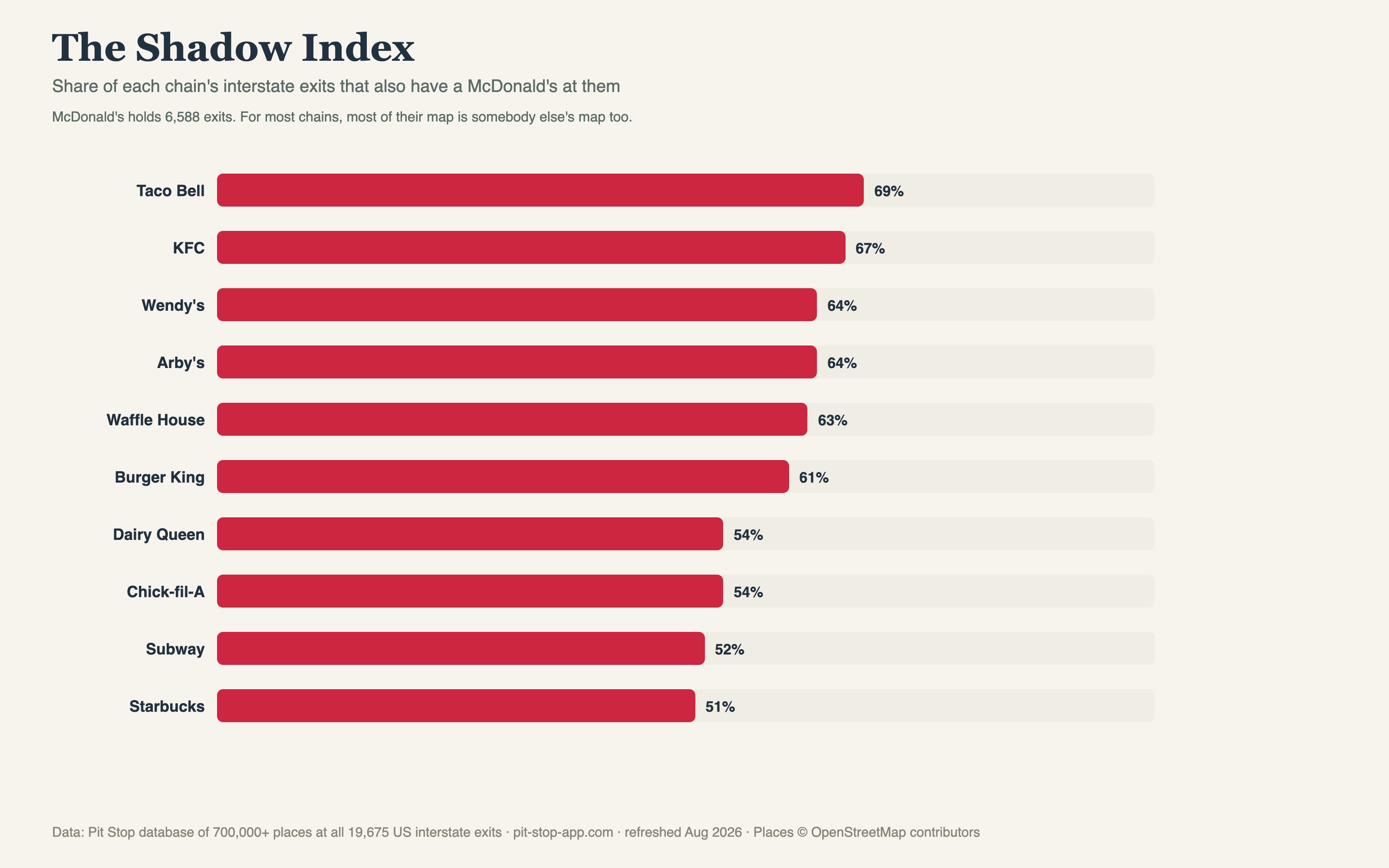
Two out of three Taco Bells at an interstate exit share that exit with a McDonald's. The chain famous for shadowing McDonald's, Burger King, is actually the least shadowed of the big three burger rivals.
The follower legend, checked
The old story is that Burger King saved money by letting McDonald's do the site research, then building across the street. At exit level, the legend is real but incomplete: 2,041 of Burger King's 3,474 exits (61%) also have a McDonald's. But Taco Bell out-shadows it at 69%, and Wendy's at 64%. Everyone follows the leader. Burger King just got the reputation.
Flip the index around and the asymmetry is stark: only 31% of McDonald's exits have a Burger King. McDonald's stands alone at more than 4,500 exits — the chain that can carry an exit by itself, at interchanges too small for anyone else's unit economics. That's the real moat: not the burgers, the sites.
The one chain that doesn't need the shadow
Subway's shadow score is the lowest of any major chain at 52%, and it's the only one that rivals McDonald's in raw footprint (6,286 exits). The two empires are built opposite ways: McDonald's owns the biggest exits and the urban loops, Subway spreads thin across everything, including thousands of small-town exits where it's the only national brand at the ramp. On primary two-digit interstates, Subway actually out-exits McDonald's 4,316 to 4,292; McDonald's retakes the lead only when you add the city beltways.
So the interstate has two kings with different crowns: McDonald's rules where the traffic is, Subway rules where it isn't.