The Dollar Store Next Door
You have noticed it even if you never said it out loud. Pull into almost any small town in America and there they are, a Dollar General and a Family Dollar, sometimes sharing a parking lot, sometimes glaring at each other across the road. Two dollar stores in a town that barely supports one gas station. It feels like a coincidence every time. It is not.
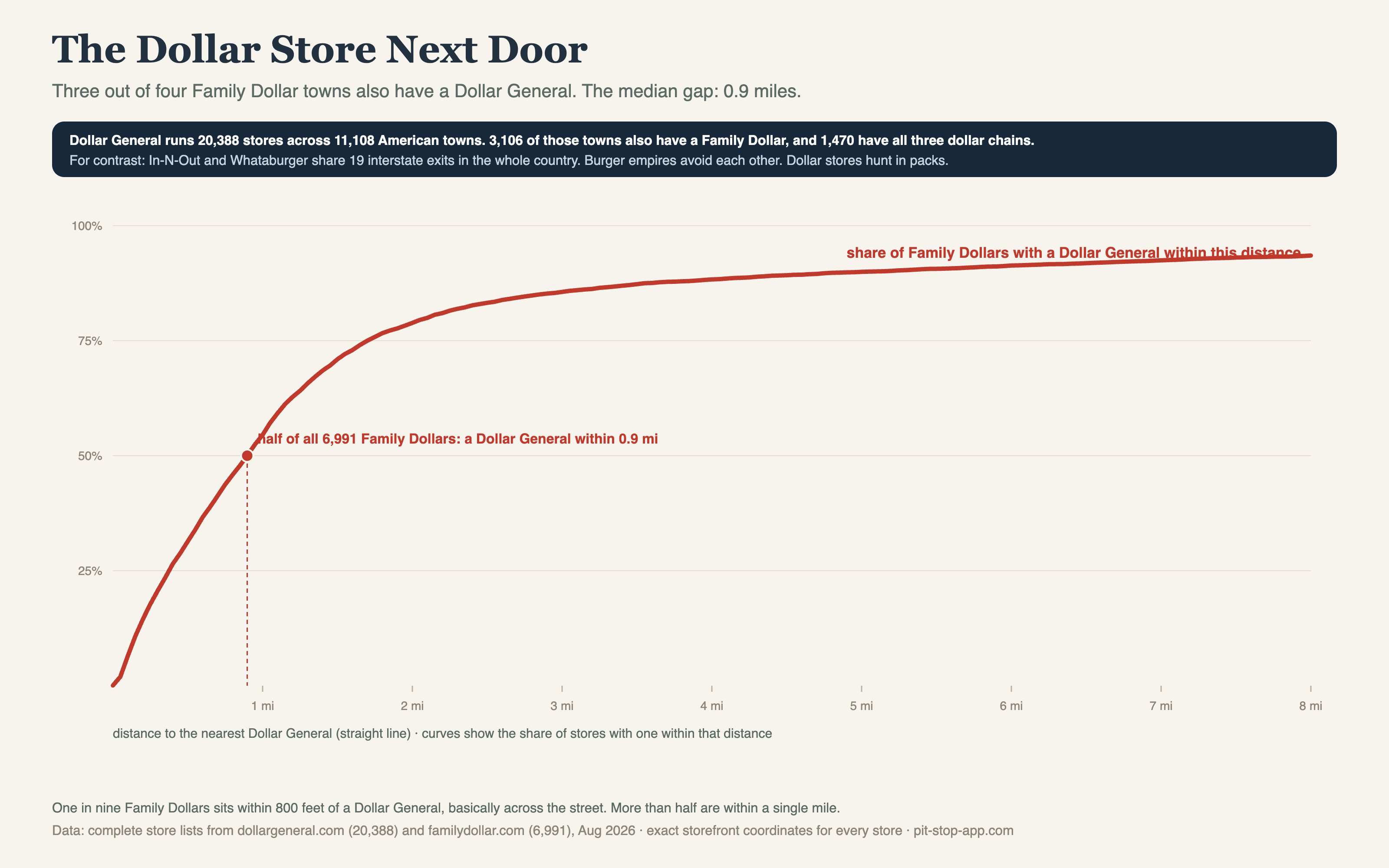
We measured it, twice. First from OpenStreetMap data, and then, after a reader question about two specific small towns sent us digging, from the chains own websites: the complete Dollar General store directory, all 20,388 stores across 11,108 towns, and Family Dollar and Dollar Tree location lists, every store they operate.
And one in nine Family Dollars, 757 of them, sits within 800 feet of a Dollar General. That is not near each other. That is across the street. These distances are exact: we measured every Family Dollar against the precise storefront coordinates of all 20,388 Dollar Generals.
Play with it
We also built an interactive version: every mapped store as a point of light, with a thread connecting each of the 2,742 Family Dollars that has a Dollar General within two miles. Zoom into your town and see the pairs. Open the interactive map →
The hometown check that upgraded the data
When we first ran this with OpenStreetMap data, a hometown sanity check came back weird: Oxford, Ohio showed one Dollar Tree and nothing else, which anyone who has driven through Oxford knows is wrong. So we went to the source and pulled the chains own store directories. Sure enough: Oxford has two Dollar Generals and no Family Dollar at all, Dollar General doubled up on a college town of 23,000 before its rival even showed up. And Liberty, Indiana, population about 2,000, has the classic pair: one Dollar General, one Family Dollar, a few blocks apart, confirmed by both companies websites. One town over from each other, two entirely different dollar store wars.
The complete directory also settled just how big this footprint is: Dollar General alone operates in 11,108 American towns, and in 28% of them it runs two or more stores. 1,470 towns host all three chains.
The opposite of a border war
Last week we mapped In-N-Out against Whataburger and found two empires that avoid each other almost completely, 19 shared interstate exits in the entire country. The dollar chains are the photographic negative of that. There is no border, no fortress, no DMZ. Wherever one goes, the other is already there or shows up shortly after. Burger chains partition America. Dollar stores hunt in pairs.
Why they crowd each other
The short version is that they are not really fighting over the same wallet moment even though they sell overlapping stuff. Dollar General builds small boxes fast and cheap on the edge of town where land costs nothing, and its site selection is famously aggressive: put a store wherever there are a few thousand people and a highway, and saturate. Family Dollar historically leaned more urban and in-town. When both formulas point at the same small town, both build, because the math for each store clears on its own. Neither chain needs the other to lose for its own box to work.
The result, on the ground, is the thing everyone notices and nobody measures: a town of 1,400 people with two dollar stores a minute apart. Multiply that by every small town in the country and you get the curves above.