Casinos Love State Lines. The Exit Data Proves Exactly How Much
American gambling law is a patchwork: legal here, banned there, tribal compacts in between. Laws are invisible. But build a database of every business at every interstate exit, and the laws suddenly appear on the map, wearing neon.
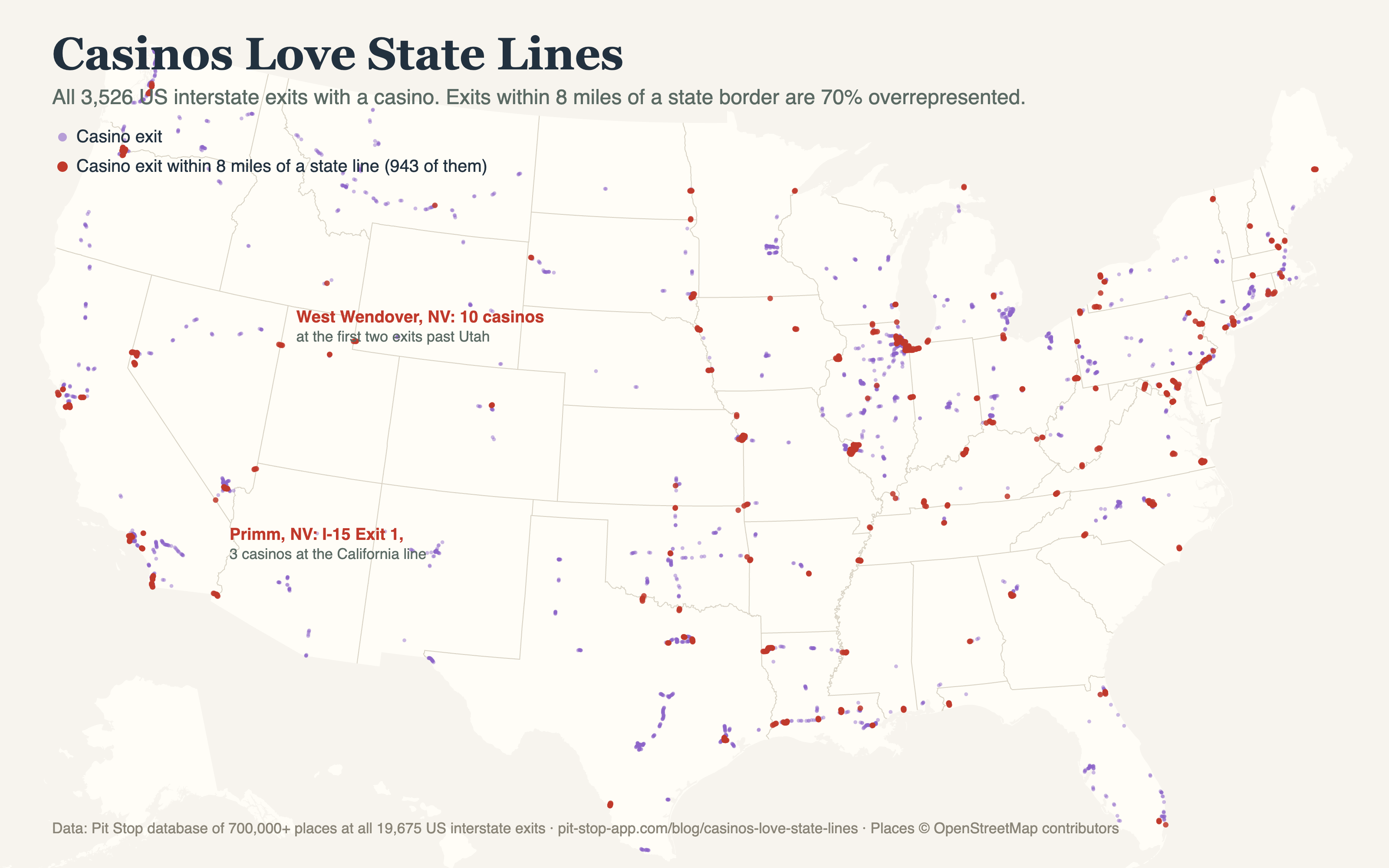
Click for full resolution.
26.7% of the 3,526 interstate exits with a casino sit within 8 miles of a state border, against a uniform expectation of roughly 15.7%. Casinos don't spread across the map. They pile up against legal walls.
The purest specimens
Primm, Nevada. Drive I-15 from Los Angeles toward Vegas and the very first exit in Nevada — Exit 1, milepost zero territory — has three casinos. Not near the border. At it. Primm exists because millions of Californians per year cross a line where gambling becomes legal, and somebody did the math on how few feet past that line a casino could stand.
West Wendover, Nevada. Same physics, different desert. I-80 crosses from Utah — where nearly every form of gambling is illegal — into Nevada, and the first two exits (407 and 410) hold ten casinos between them. West Wendover is functionally a suburb of Salt Lake City's weekend plans, 120 miles away across the salt flats.
Why the ramp matters
A casino's catchment is drive-time. When your product is illegal next door, the optimal location is the first legal parcel on the road from the biggest neighboring city — which is, almost by definition, an interstate exit at a state line. The result is a uniquely American landform: the border casino town. Primm, Wendover, Stateline. Towns whose entire reason for existing is a line on a map and an off-ramp beside it.
It also explains the data's quieter signal: heavy casino-exit counts on corridors like I-29 in Missouri and I-70 in Kansas, where riverboat and state-line rules produce the same pile-up on a smaller scale. Wherever the law changes, the exits light up.